
A Nepali business today gets enquiries from everywhere: a Facebook ad, a phone call, a WhatsApp message, a walk-in, a visitor at an expo. The enquiry is noted on a phone, a diary or someone's memory. Two days later nobody remembers who promised to call back. The customer buys from a competitor who simply followed up first.
A CRM (customer relationship management system) fixes this by giving every enquiry a home, an owner and a next step. Here is what that looks like for businesses in Nepal.
1. Every lead in one place — with its source and date
Whether a contact came from a Facebook campaign, a hotel expo in Pokhara or a referral, it goes into one list with who is responsible for it. Recording where and when the contact was obtained matters: grouping leads into batches ("Expo list, Kartik", "Facebook ad, Dashain") later tells you which campaigns actually produced customers.
2. Follow-ups that don't depend on memory
Each lead gets a next follow-up date. The CRM shows salespeople who to call today, flags leads nobody has contacted, and keeps a timeline of every call, demo and message. When a lead is won, it becomes a customer — and the onboarding work can be created as tasks automatically.
3. Messaging customers where they actually are
In Nepal, customers read WhatsApp far more reliably than email, and SMS still reaches everyone. A modern CRM should let you message by WhatsApp, SMS and email from the same screen:
- Invoices and payment reminders with a "pay online" link, so customers can pay by QR immediately.
- Receipts as soon as a payment arrives.
- Bulk campaigns — a festival offer or a service notice — to a batch of customers, each message personalised with their name, with an attachment like a brochure or price list.
Two rules make this work well. First, a person should review every message before it is sent, so nothing embarrassing goes out automatically. Second, bulk WhatsApp must be sent slowly and only to people who gave you their number — sending too fast or to strangers gets numbers blocked.
4. Payments connected to the CRM
When an invoice in the CRM has its own payment link, a paid invoice updates itself — no manual matching against bank statements. Read more in our guide to verified Fonepay QR payments.
Case study: an internet provider in Surkhet
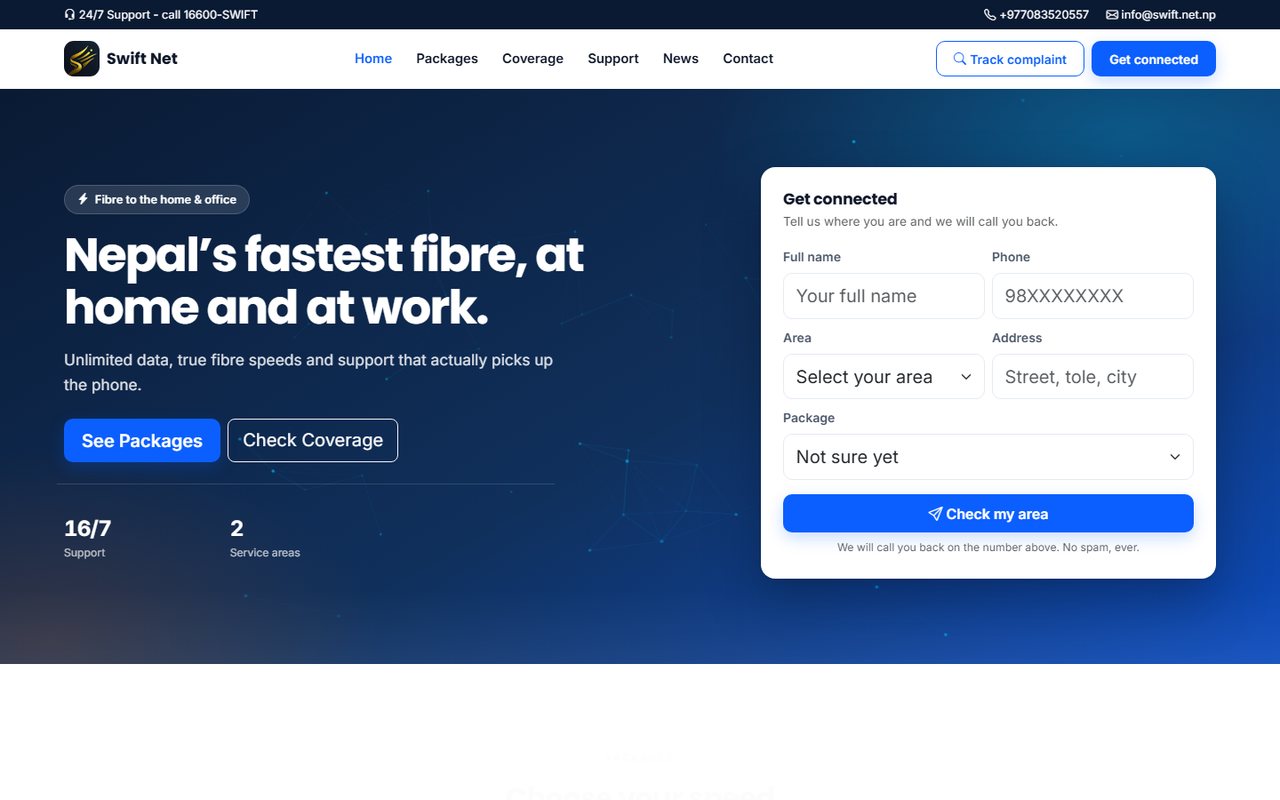
Swift Network & Communications, a fibre internet and IPTV provider in Surkhet, runs its business on a website and CRM we built. Visitors check coverage on a map and request a connection online; behind it, the team manages leads, a sales pipeline and quotations, support tickets with response-time targets and escalation, SMS notifications to staff and customers, network devices, payments, inventory and HR — all in one system.
Who benefits most from a CRM in Nepal?
- Internet providers and telecom resellers handling connections and complaints.
- Software and IT companies selling to hotels, schools and shops.
- Education consultancies and training institutes with many enquiries.
- Real estate, automobile and equipment dealers with long sales cycles.
- Hotels and travel agencies following up with corporate clients and agents.
Frequently asked questions
Is WhatsApp messaging from a CRM allowed?
Use a dedicated business number, message only customers who gave you their number, and keep bulk sending slow and relevant. Done this way, it is a normal part of customer service.
Can we import our existing contacts?
Yes — from a spreadsheet or CSV, grouped into a batch with the date the list was collected.
Do we need to install anything?
No. It runs in the browser and works on phones, so salespeople can update leads from the field.
Losing track of enquiries? Contact OM IT Solutions to see a CRM set up for your sales process. You can also browse our portfolio of systems built for Nepali businesses.